Khóa học
IELTS Online
IELTS Online
Giảm đến 18%
Đăng ký ngay
Mục lục [Ẩn]
Khi ôn tập IELTS Reading, việc luyện kĩ năng giải đề qua các đề thi thật là một cách hiệu quả giúp bạn tăng band điểm nhanh. Bài viết này sẽ giúp bạn giải đề thi IELTS Reading Cambridge 18, Test 2 “Stonehenge.” với đầy đủ đề bài, câu hỏi, đáp án chi tiết kèm giải thích rõ ràng. Đây sẽ là tài liệu hữu ích để bạn ôn luyện và nâng cao kỹ năng Reading, sẵn sàng chinh phục band điểm mục tiêu trong kỳ thi IELTS.
Stonehenge
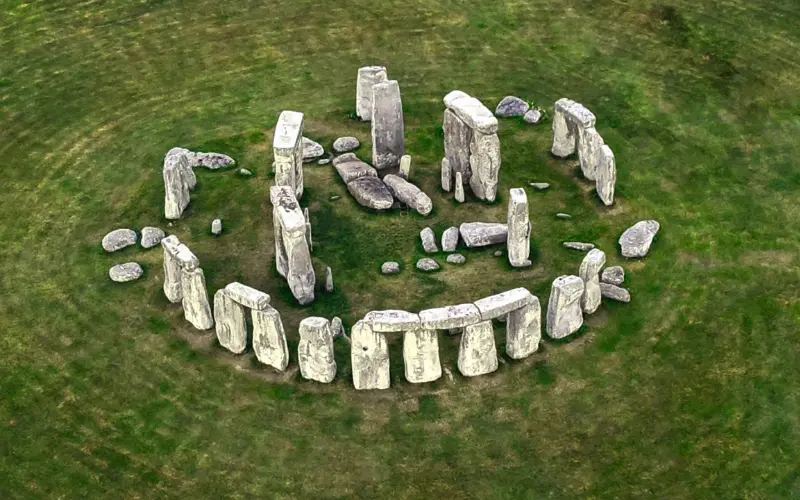
For centuries, historians and archaeologists have puzzled over the many mysteries of Stonehenge, a prehistoric monument that took an estimated 1,500 years to erect. Located on Salisbury Plain in southern England, it is comprised of roughly 100 massive upright stones placed in a circular layout.
Archaeologists believe England’s most iconic prehistoric ruin was built in several stages with the earliest constructed 5,000 or more years ago. First, Neolithic* Britons used primitive tools, which may have been fashioned out of deer antlers, to dig a massive circular ditch and bank, or henge. Deep pits dating back to that era and located within the circle may have once held a ring of timber posts, according to some scholars.
Several hundred years later, it is thought, Stonehenge’s builders hoisted an estimated 80 bluestones, 43 of which remain today, into standing positions and placed them in either a horseshoe or circular formation. These stones have been traced all the way to the Preseli Hills in Wales, some 300 kilometres from Stonehenge. How, then, did prehistoric builders without sophisticated tools or engineering haul these boulders, which weigh up to four tons, over such a great distance?
According to one long-standing theory among archaeologists, Stonehenge’s builders fashioned sledges and rollers out of tree trunks to lug the bluestones from the Preseli Hills. They then transferred the boulders onto rafts and floated them first along the Welsh coast and then up the River Avon toward Salisbury Plain; alternatively, they may have towed each stone with a fleet of vessels. More recent archaeological hypotheses have them transporting the bluestones with supersized wicker baskets on a combination of ball bearings and long grooved planks, hauled by oxen.
As early as the 1970s, geologists have been adding their voices to the debate over how Stonehenge came into being. Challenging the classic image of industrious builders pushing, carting, rolling or hauling giant stones from faraway Wales, some scientists have suggested that it was glaciers, not humans, that carried the bluestones to Salisbury Plain. Most archaeologists have remained sceptical about this theory, however, wondering how the forces of nature could possibly have delivered the exact number of stones needed to complete the circle.
The third phase of construction took place around 2000 BCE. At this point, sandstone slabs -known as ‘sarsens’-were arranged into an outer crescent or ring; some were assembled into the iconic three-pieced structures called trilithons that stand tall in the centre of Stonehenge. Some 50 of these stones are now visible on the site, which may once have contained many more. Radiocarbon dating has revealed that work continued at Stonehenge until roughly 1600 BCE, with the bluestones in particular being repositioned multiple times.
But who were the builders of Stonehenge? In the 17th century, archaeologist John Aubrey made the claim that Stonehenge was the work of druids, who had important religious, judicial and political roles in Celtic** society. This theory was widely popularized by the antiquarian William Stukeley, who had unearthed primitive graves at the site. Even today, people who identify as modern druids continue to gather at Stonehenge for the summer solstice. However, in the mid-20th century, radiocarbon dating demonstrated that Stonehenge stood more than 1,000 years before the Celts inhabited the region.
Many modern historians and archaeologists now agree that several distinct tribes of people contributed to Stonehenge, each undertaking a different phase of its construction. Bones, tools and other artefacts found on the site seem to support this hypothesis. The first stage was achieved by Neolithic agrarians who were likely to have been indigenous to the British Isles. Later, it is believed, groups with advanced tools and a more communal way of life left their mark on the site. Some believe that they were immigrants from the European continent, while others maintain that they were probably native Britons, descended from the original builders.
If the facts surrounding the architects and construction of Stonehenge remain shadowy at best, the purpose of the striking monument is even more of a mystery. While there is consensus among the majority of modern scholars that Stonehenge once served the function of burial ground, they have yet to determine what other purposes it had.
In the 1960s, the astronomer Gerald Hawkins suggested that the cluster of megalithic stones operated as a form of calendar, with different points corresponding to astrological phenomena such as solstices, equinoxes and eclipses occurring at different times of the year. While his theory has received a considerable amount of attention over the decades, critics maintain that Stonehenge’s builders probably lacked the knowledge necessary to predict such events or that England’s dense cloud cover would have obscured their view of the skies.
More recently, signs of illness and injury in the human remains unearthed at Stonehenge led a group of British archaeologists to speculate that it was considered a place of healing, perhaps because bluestones were thought to have curative powers.
Questions 1 - 8
Complete the notes below.
Choose NO MORE THAN TWO WORDS from the passage for each answer.
Write your answers in boxes 1 - 8 on your answer sheet.
Construction
Stage 1:
- the ditch and henge were dug, possibly using tools made from 1…………………………
- 2…………………………may have been arranged in deep pits inside the circle
Stage 2:
- bluestones from the Preseli Hills were placed in standing position
- theories about the transportation of the bluestones:
+ archaeological:
- builders used 3 ………………………… to make sledges and rollers
- 4………………………… pulled them on giant baskets
+ geological:
- they were brought from Wales by 5…………………………
Stage 3:
- sandstone slabs were arranged into an outer crescent or ring
Builders
- a theory arose in the 17th century that its builders were Celtic 6…………………………
Purpose
- many experts agree it has been used as a 7………………………… site
- in the 1960s, it was suggested that it worked as a kind of 8………………………….
Questions 9 and 13
Choose TWO letters, A-E.
Which TWO aspects of the planned housing development have people given positive feedback about?
9. During the third phase of construction, sandstone slabs were placed in both the outer areas and the middle of the Stonehenge site.n
10. There is scientific proof that the bluestones stood in the same spot until approximately 1600 BCE.
11. John Aubrey’s claim about Stonehenge was supported by 20th-century findings.
12. Objects discovered at Stonehenge seem to indicate that it was constructed by a number of different groups of people.
13. Criticism of Gerald Hawkins’ theory about Stonehenge has come mainly from other astronomers.
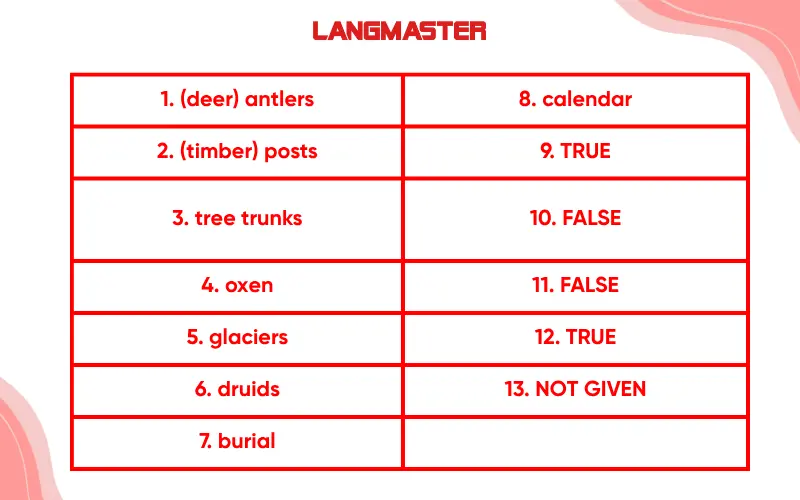
Dưới đây là bảng đáp án chi tiết:
|
1. (deer) antlers |
8. calendar |
|
2. (timber) posts |
9. TRUE |
|
3. tree trunks |
10. FALSE |
|
4. oxen |
11. FALSE |
|
5. glaciers |
12. TRUE |
|
6. druids |
13. NOT GIVEN |
|
7. burial |
Đáp án chi tiết 1 - 8
1. (deer) antlers
“Neolithic Britons used primitive tools, which may have been fashioned out of deer antlers, to dig a massive circular ditch and bank...”
→ Người Neolithic dùng gạc hươu làm công cụ đào hào và henge.
2. (timber) posts
“Deep pits… may have once held a ring of timber posts.”
→ Trong hố sâu từng có các cột gỗ dựng vòng tròn bên trong.
3. tree trunks
“Stonehenge’s builders fashioned sledges and rollers out of tree trunks to lug the bluestones...”
→ Dùng thân cây làm con lăn và xe trượt để vận chuyển đá.
4. oxen
“...hauled by oxen.” → Các giỏ đá được bò kéo đi.
5. glaciers
“...some scientists have suggested that it was glaciers, not humans, that carried the bluestones...”
→ Băng hà mang đá tới Salisbury Plain.
6. druids
“...John Aubrey made the claim that Stonehenge was the work of druids...”
→ Aubrey cho rằng druids (tu sĩ Celtic) xây Stonehenge.
7. burial
“...majority of modern scholars... Stonehenge once served the function of burial ground.”
→ Dùng làm nơi chôn cất.
8. calendar
“...Gerald Hawkins suggested... operated as a form of calendar...”
→ Hawkins cho rằng Stonehenge là một dạng lịch.
Đáp án chi tiết 9 - 13
9. TRUE
“sandstone slabs... were arranged into an outer crescent or ring; some were assembled into … trilithons that stand tall in the centre.”
→ Có đá ở cả trung tâm và ngoài cùng → TRUE.
10. FALSE
“Radiocarbon dating has revealed that work continued at Stonehenge until roughly 1600 BCE, with the bluestones in particular being repositioned multiple times.”
→ Đá bị di chuyển nhiều lần, không đứng yên → FALSE.
11. FALSE
“In the mid-20th century, radiocarbon dating demonstrated that Stonehenge stood more than 1,000 years before the Celts inhabited the region.”
→ Thuyết druids xây dựng sai → FALSE.
12. TRUE
“Many modern historians and archaeologists now agree that several distinct tribes of people contributed... Bones, tools and other artefacts found on the site seem to support this hypothesis.”
→ Có nhiều nhóm người cùng xây → TRUE.
13. NOT GIVEN
“Critics maintain that Stonehenge’s builders probably lacked the knowledge necessary to predict such events or that England’s dense cloud cover would have obscured their view of the skies.” → Bài nêu ý kiến của ‘critics’ nhưng không nói rõ những critic này là ai
→ Không nói rõ ai phê phán Hawkins → NOT GIVEN.
Khi bước vào hành trình giải đề IELTS Reading, việc xây dựng vốn từ vựng theo một lộ trình khoa học là yếu tố then chốt để cải thiện band điểm. Bài viết này mang đến danh sách từ vựng IELTS Reading quan trọng trong bài “Stonehenge” giúp bạn tăng tốc độ đọc hiểu, nâng cao khả năng phân tích thông tin và từng bước đạt kết quả tốt hơn ở kỳ thi chính thức.
|
Từ vựng |
Nghĩa tiếng Việt |
Ví dụ trong bài |
|
prehistoric |
tiền sử |
Stonehenge is a prehistoric monument that took 1,500 years to erect. |
|
monument |
công trình, di tích |
Historians have puzzled over the many mysteries of this monument. |
|
erect |
dựng lên, xây dựng |
The monument took about 1,500 years to erect. |
|
comprised of |
bao gồm |
It is comprised of roughly 100 massive upright stones. |
|
upright |
thẳng đứng |
The stones were placed in upright positions. |
|
circular layout |
bố cục hình tròn |
The stones were arranged in a circular layout. |
|
Neolithic |
thời kỳ đồ đá mới |
Neolithic Britons used primitive tools to dig a ditch and bank. |
|
primitive tools |
công cụ thô sơ |
They used primitive tools made from deer antlers. |
|
fashioned out of |
tạo ra từ |
Tools may have been fashioned out of deer antlers. |
|
ditch and bank |
hào và bờ đất |
They dug a massive circular ditch and bank. |
|
timber posts |
cột gỗ |
Deep pits may once have held a ring of timber posts. |
|
hoist |
kéo, nâng lên |
Builders hoisted about 80 bluestones into standing positions. |
|
bluestones |
đá xanh |
The bluestones came from the Preseli Hills in Wales. |
|
haul |
kéo, vận chuyển |
Builders hauled the stones over 300 kilometres. |
|
boulders |
tảng đá lớn |
They transported boulders weighing up to four tons. |
|
sledges and rollers |
xe trượt và con lăn |
They may have used sledges and rollers made from tree trunks. |
|
rafts |
bè gỗ |
The stones were floated on rafts along the Welsh coast. |
|
fleet of vessels |
đội tàu, thuyền |
They might have towed stones with a fleet of vessels. |
|
wicker baskets |
giỏ đan bằng liễu |
Stones were carried in supersized wicker baskets. |
|
hauled by oxen |
được bò kéo |
Stones were hauled by oxen over long distances. |
|
geologists |
nhà địa chất học |
Geologists joined the debate on how Stonehenge was built. |
|
glaciers |
sông băng |
Some scientists said glaciers carried the stones naturally. |
|
sceptical |
hoài nghi |
Most archaeologists remained sceptical about that theory. |
|
sandstone slabs |
phiến đá sa thạch |
Sandstone slabs formed the outer crescent. |
|
sarsens |
đá sa thạch lớn |
The sarsens were arranged into an outer ring. |
|
trilithons |
cổng đá ba khối |
The trilithons stand tall in the centre of Stonehenge. |
|
radiocarbon dating |
định tuổi bằng carbon phóng xạ |
Radiocarbon dating showed work continued until 1600 BCE. |
|
druids |
tu sĩ Druid |
Aubrey claimed Stonehenge was built by druids. |
|
antiquarian |
nhà nghiên cứu cổ vật |
The antiquarian William Stukeley popularized this idea. |
|
graves |
mộ |
He unearthed primitive graves at the site. |
|
summer solstice |
ngày hạ chí |
Modern druids gather at Stonehenge for the summer solstice. |
|
inhabit |
cư trú |
Radiocarbon dating showed it stood before the Celts inhabited the region. |
|
artefacts |
hiện vật |
Artefacts found on the site support this theory. |
|
agrarians |
người làm nông |
The first stage was built by Neolithic agrarians. |
|
indigenous |
bản địa |
They were indigenous to the British Isles. |
|
immigrants |
người nhập cư |
Later builders may have been immigrants from Europe. |
|
descended from |
hậu duệ của |
They were descended from the original builders. |
|
shadowy |
mơ hồ, không rõ ràng |
The facts about its builders remain shadowy at best. |
|
burial ground |
nghĩa trang |
Scholars agree Stonehenge served as a burial ground. |
|
astronomer |
nhà thiên văn học |
The astronomer Gerald Hawkins suggested a calendar theory. |
|
calendar |
lịch |
Hawkins said the stones functioned as a calendar. |
|
astrological phenomena |
hiện tượng chiêm tinh |
The points aligned with astrological phenomena like solstices. |
|
equinoxes |
xuân phân / thu phân |
Stones corresponded to equinoxes and eclipses. |
|
critics |
người phản đối, phê bình |
Critics said builders lacked knowledge to predict such events. |
|
healing |
chữa lành |
Some archaeologists think it was a place of healing. |
|
curative powers |
khả năng chữa bệnh |
Bluestones were believed to have curative powers. |
>>> XEM THÊM:
Khi ôn luyện đề IELTS Reading “Stonehenge”, nhiều thí sinh gặp trở ngại trong việc nhận diện dạng câu hỏi và vận dụng vốn từ học thuật sao cho phù hợp. Để cải thiện kỹ năng làm bài và tăng band điểm Reading, người học cần có chiến lược luyện tập khoa học, kết hợp cùng lộ trình học tập rõ ràng.
Hiểu được nhu cầu này, Langmaster đã thiết kế các khóa học IELTS online cá nhân hóa, giúp học viên xây dựng nền tảng vững chắc. Với sự đồng hành sát sao từ đội ngũ giảng viên giàu kinh nghiệm, học viên sẽ được sửa lỗi nhanh chóng trong vòng 24 giờ và định hướng phương pháp ôn luyện hiệu quả, từ đó nâng cao tốc độ đọc hiểu và chinh phục mục tiêu IELTS một cách bền vững.

Tại Langmaster học viên được:
Đăng ký học thử IELTS Online miễn phí ngay hôm nay để trải nghiệm lớp học thực tế, kiểm tra trình độ và nhận lộ trình học tập hiệu quả, giúp bạn thành thạo kỹ năng IELTS Reading và chinh phục mục tiêu IELTS!
Khi ôn luyện đề IELTS Reading “Stonehenge”, học viên không chỉ nắm vững đáp án đúng mà còn phát triển khả năng phân tích theo từng dạng câu hỏi một cách logic. Việc kết hợp từ vựng học thuật trong ngữ cảnh thực tế giúp ghi nhớ hiệu quả, đồng thời mở rộng vốn từ cần thiết cho kỹ năng đọc, chinh phục band điểm IELTS hiệu quả.





Các dạng bài phổ biến và tiêu chí chấm điểm IELTS Reading chi tiết nhất: Multiple Choice, Matching Information, Matching Headings,... và hướng dẫn chiến lược làm bài hiệu quả

Những sai lầm khi luyện IELTS Reading bao gồm: dịch từng từ, đọc hết cả bài, không đọc câu hỏi trước, không quản lý thời gian, không nắm vững kỹ năng paraphrase, viết sai chính tả
![Giải đề IELTS Reading: A brief history of humans and food [full answers]](https://langmaster.edu.vn/storage/images/2025/09/20/a-brief-history-of-humans-and-food-ielts-reading-answers.webp)
Giải đề thi IELTS Reading “A brief history of humans and food” kèm full đề thi thật, câu hỏi, đáp án, giải thích chi tiết, và từ vựng cần lưu ý khi làm bài.

Tổng hợp IELTS Reading tips hay nhất giúp bạn đọc nhanh, nắm ý chính và xử lý thông tin chính xác, tự tin đạt điểm cao trong kỳ thi IELTS.
![Giải đề IELTS Reading: The importance of law [Full answers]](https://langmaster.edu.vn/storage/images/2025/09/22/55.webp)
Giải đề IELTS Reading “The importance of law” kèm đáp án chi tiết, từ vựng quan trọng và bí quyết luyện thi hiệu quả để nâng cao band điểm.





Hơn 16 năm kinh nghiệm, đào tạo thành công 800.000+ học viên
Phương pháp giảng dạy hiện đại, học viên tiến bộ rõ rệt
Lộ trình học chuẩn quốc tế, phù hợp với nhu cầu thực tiễn
Giáo viên đạt chuẩn Quốc tế với chất lượng top đầu thị trường, giàu kinh nghiệm
Học online linh hoạt, cam kết đầu ra bằng văn bản